Cameron Peters, founder and CEO of TaxCycle. |
|
|
|
Welcome to CB Playbook, a biweekly newsletter for Canada’s business builders. Each edition takes you behind the big moves at some of the country’s leading companies, through the lens of the leaders navigating them.
Every industry has its own pressure points, from year-end deadlines to seasonal rushes that push teams to their limits. But burnout doesn’t have to be an inevitable part of the job. For some businesses, the key lies in rethinking how work gets done long before the crunch hits.
We spoke to Cameron Peters, founder and CEO of TaxCycle, about how he’s rethinking tax season to ease the pressure on his team and challenge the industry’s culture of seasonal burnout. In this story, you’ll learn: - How planning six months ahead helps TaxCycle avoid the tax-season crunch
- Why using the off-season for strategic work can reduce burnout and improve retention
- How employee benefits and wellness support long-term performance
Stay subscribed for more stories like this. - Katrya Bolger
Associate Editor, Canadian Business Magazine |
|
|
|
How TaxCycle is tackling seasonal burnout
|
Founder and CEO Cameron Peters is challenging the industry’s grind culture with a new approach to easing the annual workload crunch For Cameron Peters, founder and CEO of TaxCycle, the realization that tax season was broken didn't start in a boardroom. It came at the kitchen table in his childhood home in Carstairs, Alberta, just north of Calgary, where he saw firsthand the chaos it caused. In 1979, as the Apple II computer arrived, Peters watched his father struggle through tax season. "The kitchen table would be covered with papers for days while he sorted through everything,” he recalls. “I remember thinking, 'Surely, this new computer could be a solution to this problem.'"
That observation launched a career spanning 41 tax seasons. Peters co-founded tax software company, Cantax, at just 19 before establishing TaxCycle as a software company for accountants and bookkeepers in 2010. For decades, Peters lived by the industry standard: a gruelling sprint towards the April 30 filing deadline fuelled by late nights and takeout food. But as his colleagues started families and he welcomed children of his own, the glamour of the grind began to fade. Seasonal crunches can contribute to burnout, high turnover and disengagement, compounding Canada’s productivity crisis. A recent Telus Health index found 59 per cent of Canadian workers feel burnt out. Meanwhile, 90 per cent of finance and accounting hiring managers struggle to find qualified staff, according to Robert Half Canada, leaving existing teams overburdened.
This issue hit home for Peters when his young daughter physically grabbed his face to pull his attention away from his computer. The moment crystallized the philosophy that would shape TaxCycle. His thesis: seasonal stress isn't inevitable–it’s a failure of preparation. |
|
|
|
After years of enduring 80-hour weeks, Peters realized that tax season, while intense, was predictable. The standard "burn and churn" model was unsustainable. When he founded TaxCycle in 2010, he decided to change how his team prepared for the annual rush.
TaxCycle updates its software annually to reflect changing tax regulations and forms. While much of the industry waits for the Canada Revenue Agency (CRA) to release official forms in December, the team at TaxCycle begins shipping its first versions for the upcoming tax year six months earlier in June. "I think of it like running a ski hill," Peters says. "When December comes and the snow starts flying, that's a great time to sell tickets, but it's not a great time to build a new lift." Releasing the products early forces the team to build infrastructure before the pressure mounts. The trade-off is ambiguity: since CRA forms are embargoed until later in the year, the team develops "planning only" files based on previous years that can be easily updated once the official forms are released. This approach helps his team avoid last-minute crunches while adapting as updates become available. |
"When December comes and the snow starts flying, that's a great time to sell tickets, but it's not a great time to build a new lift." |
— Cameron Peters, founder and CEO of TaxCycle |
This timeline also helps keep the team motivated during the slow summer months. For Peters, summer is a strategic time. "In summer, it's nice to switch gears and focus on long-term planning—asking, 'How would we do this ideally?'" The approach—strategic work in the summer, tactical execution in the winter—also supports employee retention. Tax software requires specialized knowledge of undocumented nuances and regulations that take time to master. When the company brings a new team member on board, and Peters says it can often take new hires a year to become fully productive, making retaining experienced staff a priority.
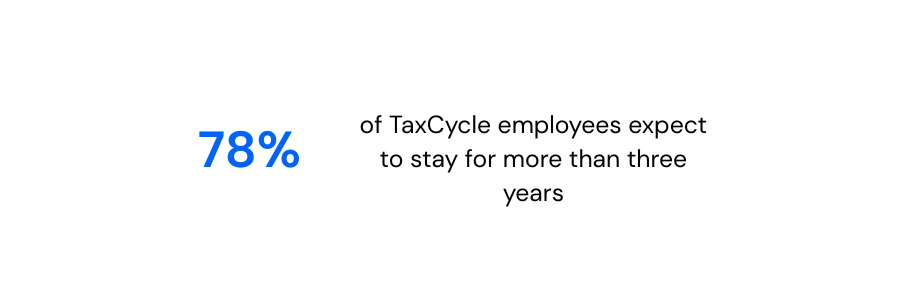
The strategy appears to be working. In the global tech sector, where the average tenure hovers around two years, TaxCycle reports that 78 per cent of their staff expect to stay for more than three years, and key co-founders have remained with the company for more than two decades. |
Beyond the calendar, Peters learned early that sustainable growth requires a safety net for both the business and its people. When a bout of severe wrist pain nearly derailed his coding career in his youth, he realized that physical health isn’t just a personal matter–it’s a business asset.
That lesson shaped how he built TaxCycle. As the company grew, he introduced a benefits plan with comprehensive coverage for physiotherapy and mental health. The company maintained this benefits approach through its acquisition by accounting software company Xero for $75 million in December 2021.
Though TaxCycle continues to operate as a standalone brand, the acquisition process revealed to Peters that these benefits aren’t just about benevolence–they’re also an investment in performance "Creating a solution [to burnout] that solves this for a large number of accountants requires creativity," he says. "I want to ensure everyone is at their best." |
|
|
|
📚 What He’s Reading: Never Split the Difference by Chris Voss. “I read—or listened to—the book three or four times. It totally changed my life. One of the key things is just remembering to acknowledge the emotions of the people you're working with, even if you don't agree with them.” 🎧 What He’s Listening To: Chai and Conversation. “My partner is Persian, and this podcast is helping me understand the culture better through the lens of history.”
⛷️ How He’s Unwinding: Skiing and wakesurfing. “I love skiing in the winter and wakesurfing in the summer. My family spends summer in Kelowna, so I spend some time on the boat with the girls. It's very nice.” |
|
|
|
Read more from CB on burnout |
→ AI was supposed to make work easier, but for many employees, it’s doing the opposite. From fear of being replaced to the pressure to do more with less, how companies introduce AI could make all the difference in whether it eases burnout or makes it worse.
→ Burnout is on the rise among Canadian workers. Enter burnout coaches, a growing group of specialists helping employees and employers find a better work-life balance.
→ Gen Z is burning out early in their careers. But understanding their expectations and the unique pressures they face creates an opportunity to reshape workplace culture for the better. |
|
|
|
©2026 All rights reserved. Reproduction in whole or in part is strictly prohibited. Canadian Business is a registered trademark of SJC Media. You’re receiving this email because you subscribed to Playbook from Canadian Business. |
|
|
|
|