Erin Bury, founder and CEO of Willful. |
|
|
|
Welcome to CB Playbook, a biweekly newsletter for Canada’s business builders. Each edition takes you behind the big moves at some of the country’s leading companies, through the lens of the leaders navigating them.
Since ChatGPT's launch in 2022, the way people discover businesses online has changed dramatically. Increasingly, consumers are turning to AI-powered tools for answers and recommendations instead of scrolling through traditional Google search results. For businesses, that shift means rethinking how they get discovered online.
Erin Bury, co-founder and CEO of online will platform Willful, started noticing this shift when more customers told her they had found the business through AI search. She decided to get ahead of the trend by embracing an answer engine optimization (AEO) strategy. In this story, you'll learn: Why more businesses are feeling the impact of the shift from traditional searches to AI discovery How an AEO strategy can help businesses reach new customers What sets AEO apart from search engine optimization (SEO)
Stay subscribed for more stories like this. - Katrya Bolger
Associate Editor, Canadian Business Magazine |
|
|
|
How Willful is adapting to AI discovery
|
Erin Bury is rethinking customer acquisition in a changing search landscape
For years, the path from a consumer question to a business website was predictable: search Google, scan the results and click a link. Now, consumers can turn directly to ChatGPT, Claude and Gemini for answers, changing how businesses reach customers online.
That shift is personal as well as professional for Erin Bury, co-founder and CEO of Toronto-based online estate planning platform Willful. When her daughter moved from a crib to a bed, Bury turned to ChatGPT, not Google, for help navigating mattress choices.
That habit now informs how she thinks about reaching Willful's customers. The company, which Bury launched with her husband, Kevin Oulds, in 2017, spent years building visibility through conventional search tactics: publishing useful information, targeting relevant keywords and earning links from credible websites.
But as consumers increasingly turn to AI tools to research personal purchases and life decisions, Bury realized they could also be using them to understand wills and powers of attorney. "If [people's] behaviour has changed because of AI, we have to assume that all of our audience is changing their behaviour as well," she says.
The stakes go well beyond one company. Research and advisory firm Gartner forecasts that traditional search engine volume will drop 25 per cent by 2026, as generative AI tools answer more questions before users even reach a company's website.
Meanwhile, research firm SparkToro estimates that most Google searches now end without a click to any website–a trend that accelerates whenever an AI Overview appears. For businesses built around Google rankings, this represents a shift in where customers come from, and whether they visit their website at all. |
|
|
|
The change is happening on two fronts. First, Google's AI Overviews answer questions more directly, potentially keeping users from visiting the full articles. For Willful, that could mean fewer visits to its Learn Centre, an online resource hub covering topics such as probate or powers of attorney.
Secondly, some consumers are skipping traditional search engines altogether. Instead of searching keywords and comparing websites, they can describe their circumstances to an AI assistant, ask follow-up questions and receive tailored explanations without ever visiting a provider.
That creates a different type of website visitor. By the time a prospective customer lands on Willful's site, Bury says, they may already understand the basics of estate planning and have a clearer idea of what they need. |
"If [people's] behaviour has changed because of AI, we have to assume that all of our audience is changing their behaviour as well." |
— Erin Bury, co-founder and CEO of Willful |
Willful's support team noticed the trend first, as callers began mentioning ChatGPT as the means by which they discovered the company. Internal data later confirmed it: in a one-month survey last March, three per cent of new signups said they’d discovered Willful through ChatGPT up from less than one per cent just months earlier.
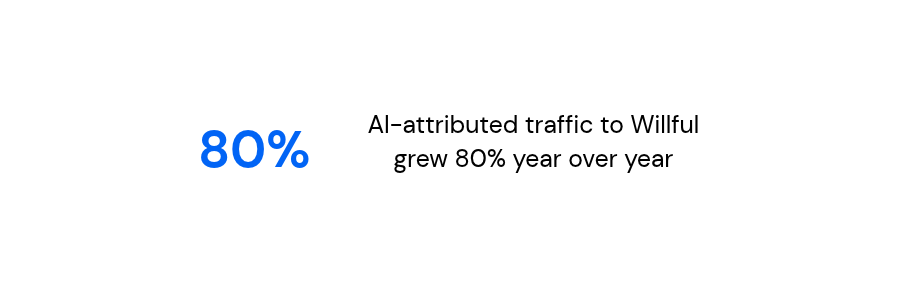
Meanwhile, AI-attributed traffic grew 80 per cent from November to April compared with the same period a year earlier. Signups from that traffic have doubled since February. AI is now Willful's fastest-growing channel outside of paid and partner referrals.
Organic search traffic began flattening about two years ago–a shift Bury says coincided with the rise of large language models. Willful began developing an AEO strategy 18 months ago. This fiscal year, AI earned its own line in the company’s revenue forecast, separate from organic and paid search.
It’s still a small part of the business, but its rapid growth and higher conversion rate mean Bury isn’t treating it as a footnote: "This [channel] needs its own dedicated resources, its own approach and strategy." |
For companies adapting to increased AI-linked searches, AEO is less a replacement for SEO than an expansion of it. The fundamentals remain similar: publish original and useful content, make it technically accessible to AI systems, and build credibility beyond a company's own website.
At Willful, that involves schema markup–structured code that helps AI crawlers and search engines understand page content–and investing in earned media, coverage in third-party publications secured through reputation and relationships. Willful manages AEO strategy in-house while working with its PR firm to build its media presence.
Willful has also started running ads directly on ChatGPT, a format so new that best practices are still emerging. But Bury says she wanted to “get in early and see what we learn.” The company has also published Learn Centre articles explaining how to use ChatGPT before users ever reach Willful's site. It’s a deliberate bet that treating AI as a research partner, rather than a threat, builds more trust than ignoring the technology. |
The younger customer signal
|
The biggest opportunity may be with younger consumers. Willful's fastest-growing customer cohort is now people aged 18 to 34, whose share of its customer base has grown from 4.6 per cent in 2020 to 11.1 per cent today, despite historically being the least likely age group to have a will.
Bury advises founders not to chase AI visibility simply because it’s new, but to first consider where customers turn for information and recommendations. “Ask yourself how your customers find you. Is AI impacting that? If yes, you should probably put some thinking into this. And if not, carry on,” she says.
For companies that have traditionally relied on search visibility, the next competitive advantage may look different. It will be less about winning a click and more about becoming a source AI systems are willing to recommend. |
|
|
|
📚 What She’s Reading: "Hollywood, Ending by John Green. I'm an avid reader and I typically read 50+ books a year, but almost none of them are business books...I recently read Green's non-fiction book Everything is Tuberculosis and loved it. So far, I'm loving this one."
🎧 What She’s Listening To: "I've been loving the Worth Owning podcast from Horizon, a value creation firm founded by my friend, Krystyn Harrison. The podcast is all about how to grow businesses with value creation in mind—value for the customers, value for stakeholders, and value for you as a founder."
🏋️ Daily Practice: "Exercise is essential to my mental health. Since I have two toddlers, most of my workouts are at 6am in my home gym. My Peloton is the best purchase I ever made, especially since there are limited fitness options in Prince Edward County (though shout-out to my favourite fitness studio, Coach Haus, founded by two amazing entrepreneurs)."
|
|
|
|
→ Consumers are increasingly turning to AI to guide their shopping decisions. Here are three ways brands can get discovered.
→ Bots now generate more web traffic than humans, but not all of them are good for business. Knowing the difference between helpful and harmful ones can help businesses protect their bottom line.
→ AI can help small businesses save time, cut costs and compete more effectively. Google Canada's Natasha Walji shares how taking small steps can help unlock the technology's potential.
|
|
|
|
©2026 All rights reserved. Reproduction in whole or in part is strictly prohibited. Canadian Business is a registered trademark of SJC Media. You’re receiving this email because you subscribed to Playbook from Canadian Business. |
|
|
|
|